

Shot Blasting
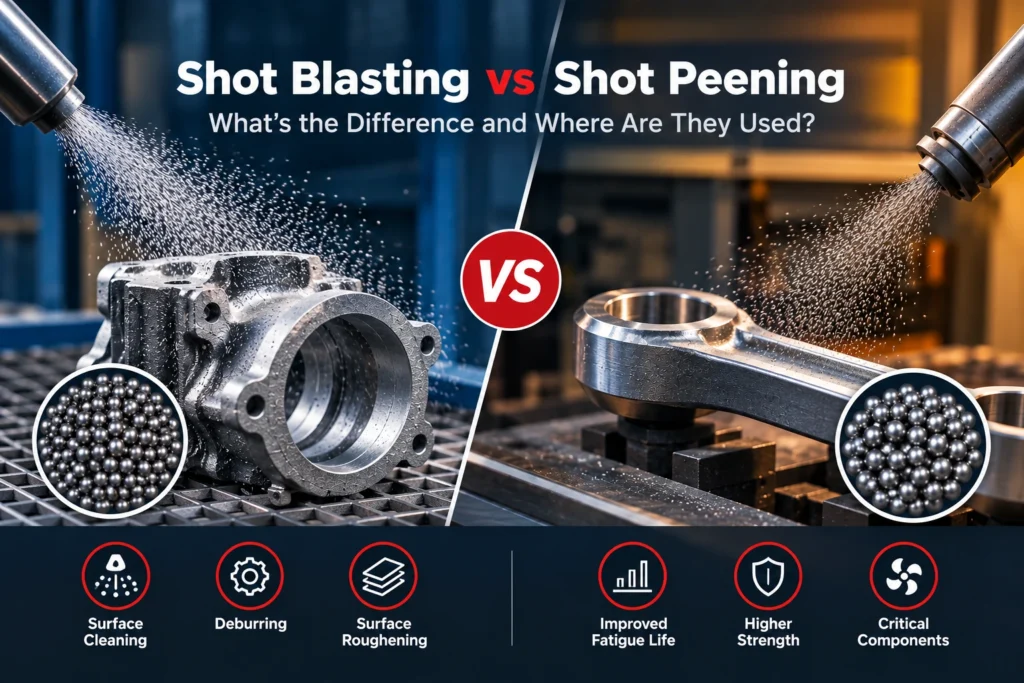
Metal components often require more than machining or casting to achieve the desired surface condition and performance. Processes such as shot blasting and shot peening are widely used across manufacturing industries to treat metal surfaces. Although both processes involve projecting metallic media at a component, their purpose, process control, and final results are significantly different.
Shot blasting is primarily associated with surface cleaning, rust and scale removal, descaling, deburring, and surface preparation, while shot peening is a controlled mechanical process used to help improve the fatigue resistance and service life of suitable components.
Understanding the difference between shot blasting and shot peening helps manufacturers select the right process, blasting or peening media, and operating parameters for their specific application.
What Is Shot Blasting -
Shot blasting is a mechanical surface-treatment process in which metallic abrasive media is propelled at high velocity against the surface of a component. The repeated impact of the media helps remove unwanted materials such as rust, mill scale, oxidation, casting sand, and other surface contaminants. Depending on the equipment and application, the media may be propelled using a wheel-blast system or compressed-air blasting system. The primary objective is generally to clean, prepare, or modify the surface condition rather than improve the fatigue properties of the component.
Common Purposes of Shot Blasting :
- Rust and corrosion removal
- Scale and oxide removal
- Cleaning castings and forgings
- Removing residual sand from cast components
- Deburring suitable components
- Surface preparation before coating or painting
- Creating a controlled surface texture
- General surface cleaning and finishing
Where Is Shot Blasting Used -
Foundries
Cast components often contain residual sand, scale, and surface contamination. Shot blasting can clean these components and prepare them for subsequent operations.
Forging Industry
Forged parts can develop oxide scale during heating. Blasting helps remove this scale and provides a cleaner surface for inspection, machining, coating, or further processing.
Automotive Industry
Various automotive components may undergo blasting for cleaning, preparation, or finishing during different stages of manufacturing.
Metal Fabrication
Fabricated steel components can require rust removal, descaling, and surface preparation before painting or coating.
Engineering Components
Shot blasting is used for a broad range of engineering parts where consistent cleaning and surface preparation are required.
What Is Shot Peening -
Shot peening also involves repeatedly impacting a metal surface with small particles, but its primary objective is different. Instead of mainly cleaning the component, shot peening is a controlled cold-working process intended to create beneficial compressive residual stresses in the surface layer of a component. When properly specified and controlled, these compressive stresses can help improve resistance to fatigue-crack initiation and propagation. This makes shot peening particularly important for components exposed to cyclic loading, vibration, repeated stress, or demanding operating conditions.
Common Purposes of Shot Peening :
- Improving fatigue resistance
- Increasing component durability
- Enhancing resistance to cyclic loading
- Reducing the risk of fatigue crack initiation
- Introducing beneficial compressive residual stresses
- Improving the service life of critical components
- Strengthening highly stressed surface areas
Where Is Shot Peening Used -
Springs
Springs repeatedly compress and extend during operation. Properly controlled shot peening can be used to improve their fatigue resistance.
Gears
Gear teeth experience repeated contact and bending loads. Shot peening may be specified for suitable gears to improve resistance to fatigue-related damage.
Automotive Components
Selected automotive components subjected to cyclic loading may undergo shot peening as part of their manufacturing process.
Aerospace Components
Shot peening is used for various aerospace components where controlled fatigue performance is important. These applications typically require tightly specified and monitored process parameters.
Shafts and Forged Components
Selected shafts, forgings, and other highly stressed components may also benefit from properly engineered shot peening.
Shot Blasting or Shot Peening: Which Process Is Required -
The correct choice depends primarily on the required result. When the objective is to remove rust, scale, oxidation, casting sand, or contaminants, shot blasting is generally the relevant process. When the objective is to improve fatigue resistance by introducing controlled compressive residual stresses, shot peening is the appropriate process.
In some manufacturing sequences, a component may undergo both processes at different stages. For example, blasting may first be used for cleaning, while a separately controlled peening operation may later be performed to meet mechanical performance requirements.
Important Factors When Selecting Cut Wire Shot
- Shot Material: Carbon steel, stainless steel, aluminium, zinc, or another suitable material may be selected according to the component and process.
- Shot Size: Particle size affects impact energy and the resulting surface condition.
- Hardness: Media hardness should be compatible with the workpiece and intended treatment.
- Conditioning Level: As-cut and progressively conditioned shots produce different impact characteristics.
- Component Material: Steel, stainless steel, aluminium, and other alloys may require different media.
- Required Surface Finish: Cleaning intensity and desired surface texture influence media selection.
- Process Parameters: Velocity, flow rate, angle, exposure time, coverage, and equipment condition can affect the final result.
Benefits of Using Quality Cut Wire Shots -
Although shot blasting and shot peening may appear similar because both involve projecting metallic media against a component, their objectives are fundamentally different.
Shot blasting focuses primarily on cleaning, descaling, surface preparation, and finishing. Shot peening is a controlled mechanical treatment designed to introduce beneficial compressive residual stresses and improve the fatigue performance of suitable components.
The effectiveness of either process depends on selecting the appropriate shot material, size, hardness, shape, conditioning level, equipment, and operating parameters.
At Bakul Casting Pvt. Ltd., we manufacture quality Cut Wire Shots for shot blasting, shot peening, and other industrial surface-treatment applications. With a focus on consistent manufacturing, controlled quality, and dependable performance, we support industries in selecting suitable Cut Wire Shot solutions for their specific processing requirements.
Need the Right Cut Wire Shot for Your Application?
Frequently Asked Questions (FAQs)
What is the main difference between shot blasting and shot peening?
Shot blasting is primarily used for surface cleaning, rust and scale removal, descaling, and surface preparation. Shot peening is a controlled process used to introduce compressive residual stresses that can improve fatigue resistance and component durability.
Can the same Cut Wire Shots be used for shot blasting and shot peening?
Cut Wire Shots can be used in both processes, but the required size, hardness, shape, and conditioning level depend on the component, equipment, and specific process requirements.
What are the common applications of shot blasting?
Shot blasting is commonly used for cleaning castings and forgings, removing rust and scale, deburring, descaling, surface finishing, and preparing metal surfaces for painting or coating.
Which components commonly undergo shot peening?
Shot peening is commonly applied to components exposed to repeated or cyclic stresses, including springs, gears, shafts, automotive parts, forged components, and selected aerospace components.
Why are conditioned Cut Wire Shots suitable for shot peening?
Conditioned Cut Wire Shots have a more rounded and consistent profile, helping provide controlled and repeatable impact. Proper media selection and process control are important for achieving the required peening results.